
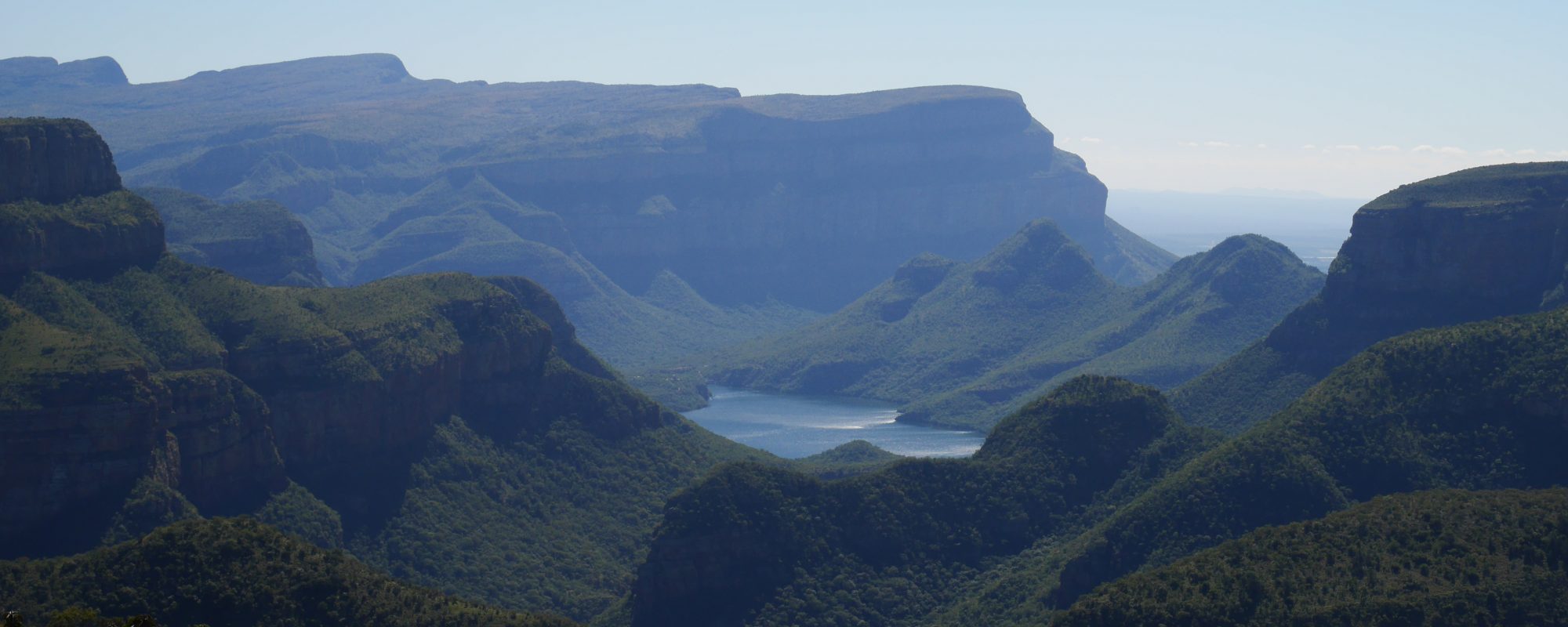
Tucked away in the lush, green heart of Asturias, Covadonga is a destination that feels like it belongs in a storybook. This small yet profoundly significant place offers visitors a perfect blend of history, spirituality, and natural beauty, making it a must-visit for anyone exploring Spain. Whether you’re a history buff, a nature lover, or simply seeking a peaceful retreat, Covadonga has something to offer.

Why Visit Covadonga?
Covadonga is more than just a dot on the map; it’s a place where history and legend intertwine with breathtaking landscapes. As the legendary site of the Battle of Covadonga in 722 AD, this small town is often credited as the birthplace of the Reconquista—a pivotal moment in Spanish history. Beyond its historical significance, Covadonga is also the gateway to the Picos de Europa National Park, one of Spain’s most stunning natural reserves.
The Sanctuary of Covadonga: A Journey Through Time
Your visit to Covadonga should start at the Sanctuary of Covadonga, a site that’s both sacred and awe-inspiring. The Sanctuary is nestled within a dramatic natural setting, where mountains rise steeply around it, and the atmosphere is thick with the scent of pine trees.

- The Basilica of Santa María la Real de Covadonga
The majestic Basilica, built of pink limestone, stands proudly against the backdrop of the Picos de Europa. Its neo-Romanesque architecture is a marvel, and stepping inside, you’ll be struck by the sense of reverence that fills the air. The interior, with its grand arches and serene altars, invites quiet contemplation. - The Museum is a fascinating stop for families eager to dive deeper into the rich history and legends of this iconic Asturian site. Located near the sanctuary, the museum offers engaging exhibits that explore the region’s cultural heritage, including the legendary Battle of Covadonga and the significance of the Virgin of Covadonga. With interactive displays, historical artifacts, and informative panels, the museum presents a captivating experience for visitors of all ages.
- Holy Cave (La Cueva Santa)
A short walk from the Basilica leads you to the Holy Cave, where you’ll find a small chapel dedicated to Our Lady of Covadonga. According to legend, this cave was the refuge of Pelayo, the Asturian nobleman who led the Christian resistance against the Moors. The image of the Virgin Mary, known as La Santina, holds a special place in the hearts of Asturians, and many pilgrims come here to pay their respects. - The Cascada del Río Deva
Just beneath the Holy Cave, you’ll find the Cascada del Río Deva, a picturesque waterfall that adds to the mystical aura of the site. The sound of water cascading down the rocks into the emerald pool below creates a serene ambiance, perfect for reflection

You can find more information under https://santuariodecovadonga.es
Exploring the Lakes of Covadonga
No trip to Covadonga is complete without a visit to the nearby Lakes of Covadonga—Enol and Ercina. These glacial lakes, perched high in the mountains, are surrounded by verdant meadows and jagged peaks, offering some of the most stunning scenery in all of Spain.

- Getting There
From the Sanctuary, it’s a scenic drive up to the lakes, with winding roads that offer breathtaking views at every turn. During peak season, from July to September, access to the lakes is restricted, and visitors must take a shuttle bus from the parking area. However, visiting in the early morning or late afternoon allows for a more peaceful experience. - The Lakes
Lake Enol is the larger of the two and is often the first to greet visitors. Its crystal-clear waters reflect the surrounding mountains, creating a mirror-like effect that’s simply mesmerizing. A short walk away lies Lake Ercina, which is equally beautiful and often quieter, making it a perfect spot for a picnic. - Hiking Trails
For those who love hiking, Covadonga offers several trails that cater to different levels of fitness. The Ruta de los Lagos is a popular choice, taking you on a gentle loop around the lakes, with plenty of opportunities to spot wildlife like chamois or golden eagles. For a more challenging trek, the trail to Mirador de Ordiales rewards hikers with panoramic views that stretch across the Picos de Europa.
campervan travel
It is very easy to travel Covadonga in a campervan as there are a couple of parking areas specifically for campervans where you can also spend the night. However, a few things need to be planned ahead.
Parking areas and transportation
In high season, the road up to the lakes is forbidden for tourists due to the high amount of people visiting the area. You should book your alsa bus in advance. In August, we saw many disappointed people who were not able to catch a bus until late in the afternoon. When booking your ticket, you need to chose the right parking area to make sure that you can take your bus. This is, of course, challenging because you never know whether you will find a place at the parking area of your choice.
We spent the night on the P3 (Muñigo) as it looked nicer and calmer than the P1 in Cangas de Onis. However, we had booked the ticket from P1 thinking that the bus would stop at every parking area. Unfortunately, this was not the case and we had to take one of the buses going down to Cangas de Onis in order to catch our bus. One the way back, we did not have the same problem as the driver let us leave the bus. However, we lost some precious time at the beginning.
You can book your tickets directly via the alsa website.


Plan your visit
If you want to see everything in one day, we would recommend to first go all the way up to the lakes, hike the Ruta de los Lagos, take the bus back down and stop at Covadonga’s historical sites on your way back.
However, travelling in a campervan also allows you to take two days. You can spend one day hiking at the lakes and the second day visiting the historical site of Covadonga. If you want to avoid long days and still want to visit all the different sites, including the museum, this is the way to go, especially when travelling with children.
Travelling with kids
Covadonga and its lakes provide a safe and captivating environment for families. Accessing the lakes by bus is quite easy and while children under 3 travel for free, older children up to 12 years old pay a reduced fee.
If you want to walk around the lakes with smaller kids, you should bring a baby carrier as the way up is not always stroller friendly. However, there is plenty of space for kids to run around at Lake Enol. A close encounter with local cows can also be a fun experience for the youngest.
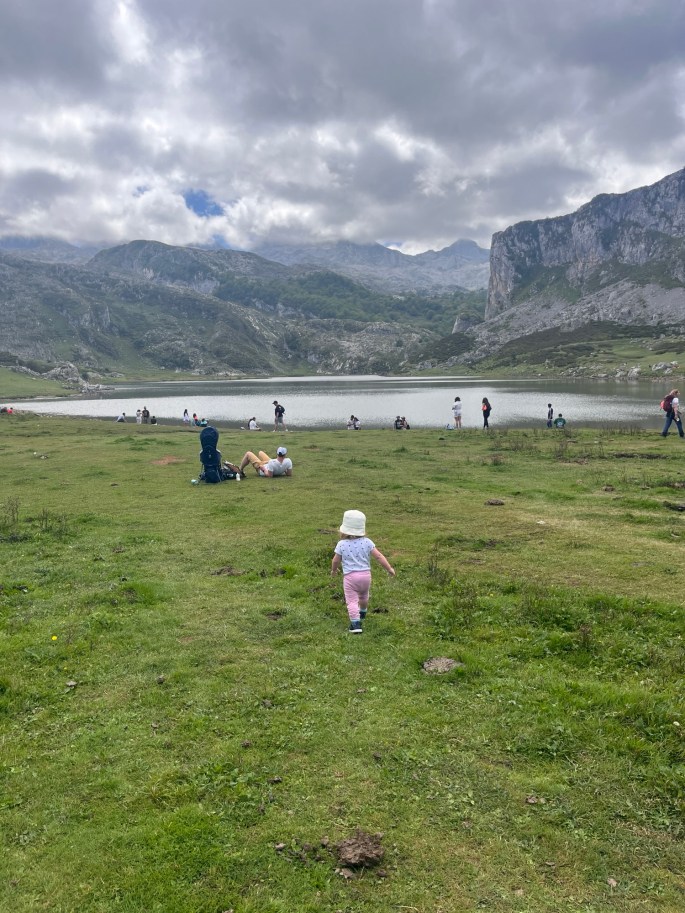
The sanctuary of Covadonga is equally easy to visit with kids. Children will be fascinated by the legends surrounding this site, and the short walk to the cave offers a manageable adventure for young explorers.
Practical information
- In high season, the road up to the lakes is forbidden for tourists. You can book your tickets directly via the alsa website.
- The most famous hike is the Ruta de los Lagos, which is easy to hike with children.
- The Basilic is open every day from 8 am to 8 pm.
- The museum can be visited between 10.30 and 14.00 and 16.00 and 18.30 (19.00 during high season).
- P3 and P1 are suitable parking areas for campervans, you need to book your alsa tickets accordingly.
* * *
You might also like

Exploring Northern Spain by Campervan: A Journey through Asturias and Cantabria
If you’re craving a road trip that combines dramatic coastlines, emerald-green mountains and beautiful beaches Northern Spain—particularly the regions of Asturias and Cantabria—offers one of Europe’s most underrated campervan adventures. This corner of the Iberian Peninsula is a perfect destination for nature lovers, surfers, foodies, and slow travelers seeking an experience far removed from the…

Fuente Dé: A family friendly mountain experience in the Spanish Picos de Europa
If you’re looking for a family-friendly escape in the mountains, Fuente Dé in Northern Spain should be on your radar. Nestled in the heart of the Picos de Europa National Park, this hidden gem is a stunning blend of rugged peaks, alpine meadows, and panoramic views that take your breath away—literally and figuratively.
Whether you…
Exploring Bardenas Reales in a Campervan
Spain is often celebrated for its rich history, vibrant cities, and sun-soaked coastlines. But tucked away in the northern region of Navarra lies a natural wonder that defies the typical image of the country. The Bardenas Reales, a semi-desert landscape covering over 42,000 hectares, is one of Spain’s most unique terrains. With its surreal rock…
3 weeks camper van trip to Southern Sweden
With what is going on at the moment, travelling in a campervan is definitely a great option and Sweden is one of the most camper van-friendly countries in Europe. It has a very open policy with regards to camping and other outdoor activities and it is one of those countries which is not overcrowded even…
 Time off around the world